EVE-1 — Event-Level Transformer
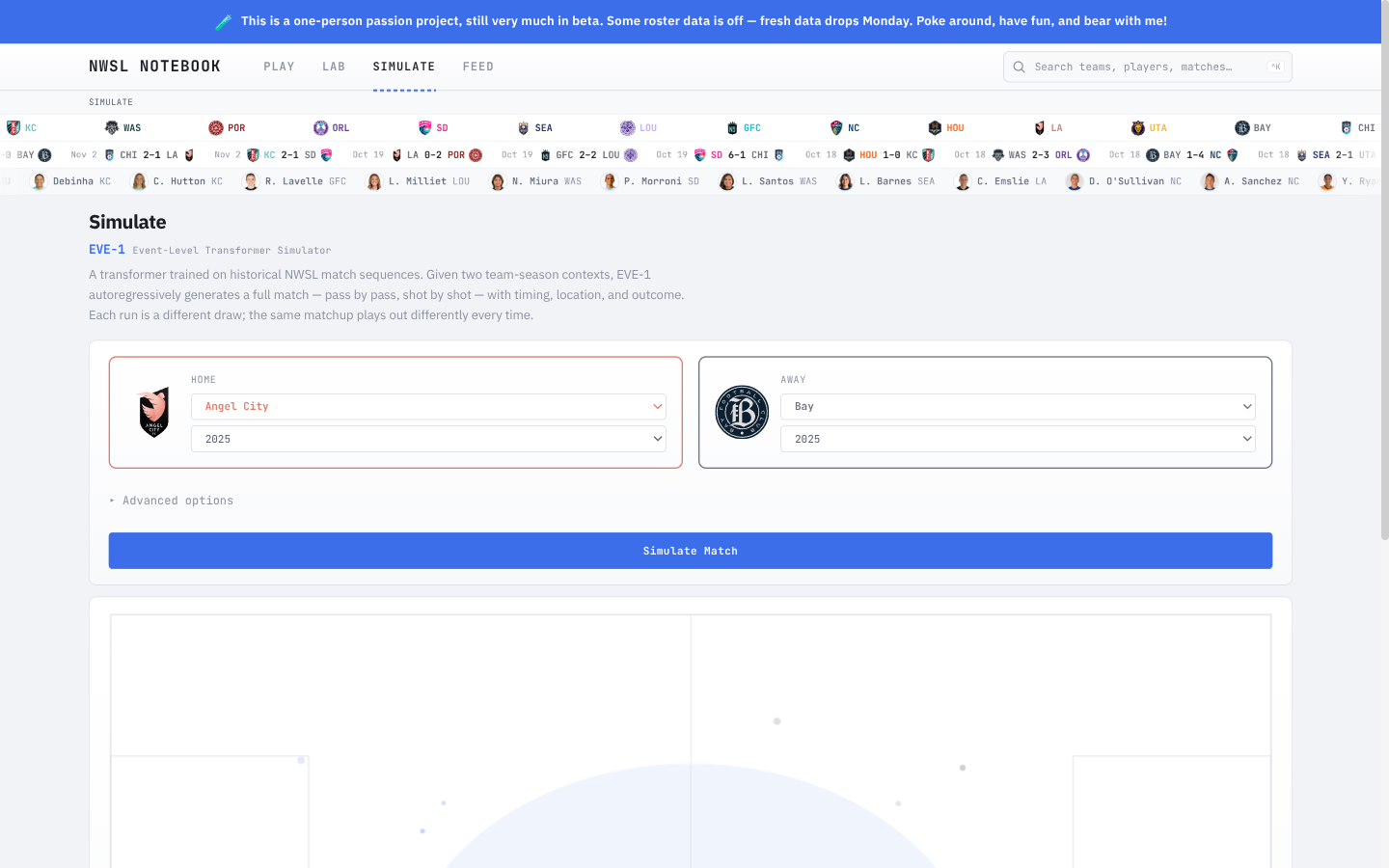
EVE-1 is a generative match simulation model. Given two teams and their season contexts, it autoregressively generates a full match — pass by pass, shot by shot — with timing, location, and outcome. Each run is a different draw; the same matchup plays out differently every time.
What EVE-1 Does
Traditional match prediction models output a scoreline or a win probability. EVE-1 is different — it generates the entire sequence of events that constitute a match. Every pass, carry, tackle, shot, and goal is produced in order, with pitch coordinates and minute timestamps. The final score is an emergent property of the generated event sequence, not a direct prediction.
This means you don't just get “Team A wins 2-1.” You get the story of how they won — the buildup play, the defensive actions, the momentum shifts, the individual moments that decided the match.
How It Works
Each team is represented by its season context — a rich encoding of how that team plays in a given year. This captures tactical patterns, formation tendencies, pressing behavior, build-up style, and personnel characteristics derived from the full season of event data.
Given the two team contexts, EVE-1 generates match events one at a time. Each new event is conditioned on everything that came before — the current score, who has possession, where the ball is, what just happened. The model learns these transition dynamics from thousands of real NWSL match sequences.
Each generated event includes: event type (pass, shot, tackle, etc.), pitch coordinates (x, y on a 105×68m pitch), match minute, team side (home/away), and outcome (success, blocked, saved, goal). Events stream in real-time as the simulation runs.
The model generates events until it reaches full time (90 minutes plus injury time). Goals, cards, and the final score emerge naturally from the event sequence. The match duration and injury time are determined by the model as part of generation.
Decode Strategies
How the model samples the next event from its probability distribution affects the character of the simulation. Two strategies are available:
Sampling accounts for possession context, producing more realistic ball retention patterns and phase transitions. Matches tend to flow more naturally, with coherent buildup sequences.
Alternative decoding that prioritizes calibrated outcome distributions. Score distributions more closely match historical base rates, at the cost of slightly less coherent in-match sequences.
Stochasticity & Random Seeds
EVE-1 is stochastic — the same matchup produces different results every time. This is by design. Real soccer has irreducible randomness: a deflection, a misplaced pass, a goalkeeper's moment of brilliance. The model captures this by sampling from learned distributions at each step.
For reproducibility, you can set a random seed. The same teams, same seasons, and same seed will always produce the identical event sequence. This lets you share specific simulations or compare decode strategies on an apples-to-apples basis.
Training Data
EVE-1 is trained on SPADL-converted event sequences from all NWSL seasons (2016 to present). Each training example is a complete match represented as a sequence of actions with spatial coordinates, timing, and outcomes. The model learns the statistical structure of how NWSL matches unfold — which actions follow which, how different team styles interact, how match state influences what happens next.
Team-season contexts are derived from the same embedding infrastructure used throughout NWSL Notebook. This means a simulation of “2024 Orlando Pride vs 2023 Portland Thorns” uses the actual tactical fingerprints of those specific team-seasons.
What You Get From a Simulation
After a simulation completes, NWSL Notebook analyzes the generated event sequence to produce:
- --Match summary — final score, possession %, shots, passes, defensive actions
- --pG momentum — post-shot expected goals tracked through the match, showing how scoring pressure built and released
- --Phase detection — dominant possession periods identified automatically, showing who controlled the match and when
- --Event timeline — full chronological event list with filtering by type, team, and match phase
- --Pitch zone map — spatial visualization of where actions occurred, revealing tactical patterns in the simulation
- --Match narrative — AI-generated analysis of how the simulated match unfolded
Limitations & Caveats
EVE-1 is a research model, not an oracle. Important limitations:
- !Simulations reflect statistical patterns, not tactical intelligence. The model doesn't “understand” soccer — it generates plausible sequences from learned distributions.
- !Individual player identity is not modeled. Team-season contexts capture collective style, not specific player abilities.
- !The model is trained on NWSL data only. Cross-league simulations or comparisons to other leagues are not meaningful.
- !Score distributions are approximate. While the model captures the shape of realistic scorelines, it should not be used for prediction or betting purposes.
Pick two teams, hit simulate, and watch a match unfold event by event.